


What are Fundamental Movement Skills?
Fundamental Movement Skills (FMS) are the basic building blocks of movement that children develop as they grow. These movement patterns are used in everyday activities and also underpin more complex physical activities and sports. They form the foundations of physical literacy.
Fundamental Movement Skills can be grouped into three main categories. They are:
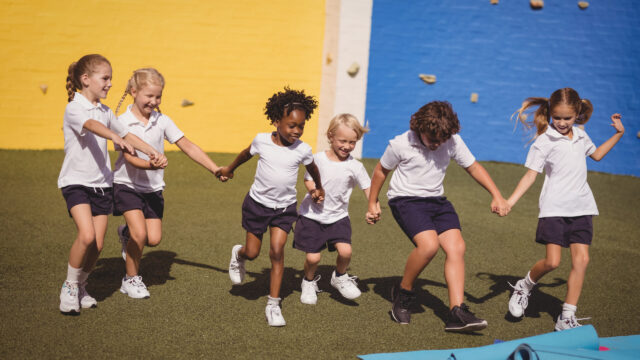
- Locomotor Skills – These involve moving the body from one place to another, such as jumping, running, hopping and skipping.
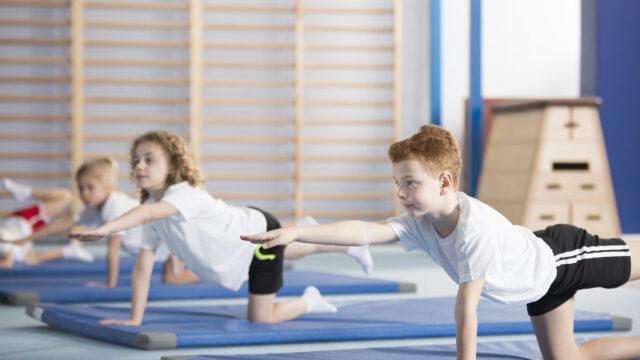
- Non-locomotor Skills – These are movements performed without travelling, such as balancing, twisting, bending, stretching and turning.
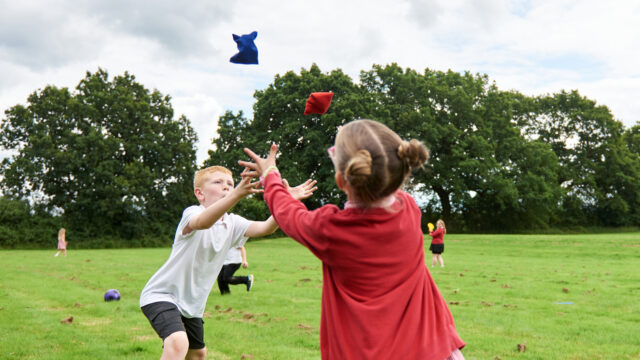
- Object Control Skills – These involve the handling of objects, such as throwing, catching, kicking, striking and rolling.
Developing skills across all three of these areas is important in helping children to grow in their physical confidence.
Why Are Fundamental Movement Skills Important?
Fundamental Movement Skills play a crucial role in children’s physical and cognitive development. They are closely linked to physical literacy, which is the motivation and confidence to be active.
When children develop strong Fundamental Movement Skills:
- They gain confidence with participating in sports and physical activities.
- They are more likely to develop good habits around leading an active lifestyle.
- They develop their coordination and balance.
- They support cognitive development including concentration and problem solving.
When should children learn Fundamental Movement Skills?
The early years of a child’s development are especially important for developing Fundamental Movement Skills because this is when movement patterns are first established. During this time, children are often motivated, interested and excited to explore their movement.
Experts suggest that the ideal window for really embedding and extending Fundamental Movement Skills is between the ages of 3 and 10.
Development typically progresses through stages:
- Ages 3 to 5 – Children experiment with basic movements such as running, jumping, and throwing. Skills are often inconsistent and require lots of exploration.
- Ages 5 to 7 – Movements become more controlled and coordinated. Children can follow simple instructions and start combining skills.
- Ages 7–10 – Skills become more refined and adaptable. Children can apply them in games and sports contexts.
How to teach Fundamental Movement Skills
Here are 5 top tips for teaching and supporting Fundamental Movement Skills:
Start with Basic Movements
As with all learning, focus on laying strong foundations. Begin with simple movements and avoid overwhelming children by introducing one skill at a time. Use clear demonstrations and simple language to explain the movement. Also, allow lots of time and opportunities for repetition, exploration and practise. Building confidence in these basic movements will help them to be ready when you introduce more complex skills later.
Use Games-Based Learning
We know that children learn best when they are engaged, interested and enjoying themselves. Plan games that will get children excited about practicing their new skills. For example, a traffic lights game for running, or a beanbag toss for throwing. You could also make up imaginative games such as pretending to be different animals or a superhero on a rescue mission!
Break Skills into Steps
Build children’s understanding and confidence by helping them to break down the movement. Start by demonstrating the full movement and then break it down into individual movements. For example for throwing, Stance – Arm Swing – Release. Encourage children to practise each part and then combine!
Provide Feedback and Encouragement
Many of us are now very confident with our movement skills and it can be hard to remember how we learnt to skip, run or throw, and how it felt when we did. For our young learners, these are huge skills to learn and can be tricky for some. Keep offering encouragement, constructive feedback and praise as they learn to use their bodies in lots of new ways.
Adapt for Different Ability Levels
As we know, every child is unique. Be ready to adapt activities to cater for different skill or confidence levels to help scaffold, support and extend if needed. For example, you might use different sized equipment (e.g. larger balls for beginners or larger hoops as targets), adjust distances, or provide additional challenges.
10 Fundamental Movement Skills Activities for Kids
Here are some practical activities that could be used within provision in Early Years, or as part of a PE lesson with older children to help practice FMS:
- Obstacle Courses – Set up a course with various challenges that encourage children to use different skills, such as running, crawling, jumping, and balancing.
- Throw and Catch Games – Use different equipment to setup throwing and catching challenges. You could use balls of different shapes, textures and sizes. Starting with beach balls or balloons can help slow down the ‘drop’ of the ball to help with hand-eye coordination practise.
- Balance Challenges – Children could balance on one foot, walk along beams or walk a tight rope along a skipping rope line.
- Jumping Games – You could play hopscotch games, create jumping challenges or jump between equipment markers.
- Relay Races – Organise teams and let them compete in different locomotor skills races. Great for developing teamwork skills!
- Target Throwing – Aim at hoops, cones or wall targets. You could number the targets to include a bit of maths learning too!
- Animal Movements – Have some fun and explore different animal movements, such as frogs jumping, crabs skuttling or bear cubs crawling.
- Balloon Volleyball – The balloon helps this to be a great slower paced activity where children will develop their hand-eye coordination and striking skills.
- Mirror Movements – Children work in pairs and take it in turns to copy their partner’s movement.
- Simon Says – A classic but great activity for reinforcing listening skills while exploring movements.
Example PE Lesson for Fundamental Movement Skills
Here is a simple example of a PE lesson that introduces and teaches Fundamental Movement Skills:
- Warm-up: Start with light stretching, slow jogging, or a simple game such as traffic lights to raise heart rates and loosen muscles.
- Skill Focus: Introduce and demonstrate the new skill, for example throwing. Break down the skill into the smaller steps and model each step, calling out key teaching points such as when to release.
- Activity or Game: Set up an activity or game that uses this new skill and lets children practise the skill in context. Remember to think about ways you could scaffold/support if children are finding it tricky, or how to extend learners for those that are confident.
- Cool Down: Finish the session with some gentle stretching and movements to cool down the muscles. As children do this, encourage them to reflect on what they have learnt.
Following a similar structure for lessons when introducing and learning new skills will help children to feel secure, confident in routine and calm as they know what to expect.
How to Assess Fundamental Movement Skills
Assessment does not need to be tricky or complex. Simple observations can give you a lot of valuable insight and you can plan next steps whilst in the moment.
- Observe – watch children as they practice their skills and look for key aspects such as balance, coordination and control. Sometimes we observe a difficulty in a skill and there can be a few underlying reasons that are making it tricky.
- Checklist – You could create or use a simple checklist of movement skills to mark off as you see children master that skill, such as ‘can jump with two feet, can hop on one foot, can catch a ball etc.
- Track progress – Everything takes time to master, so keep records of each child’s development over time and the new skills they are learning. This may also identify any gaps, which need additional support so they can develop more complex skills.
Common Mistakes when Teaching Fundamental Movement Skills
Here are a few areas that teachers have shared that they are always careful of:
- Too much structure – try to avoid making activities too rigid. Flexibility in sessions and activities will bring creativity, fun and enjoyment as children learn to move their bodies in different ways.
- Not enough repetition – These skills require a lot of practice to really become confident. Ensure you plan in lots of time to revisit and repeat the skills in lots of different ways and contexts.
- Jumping into the game – It can be tempting to jump in and start playing team games, such as rounders quite quickly. But before playing, remember that children need the chance to develop the Fundamental Movement Skills that are needed to be successful when playing the game, such as running, throwing, striking and catching.
- Focussing on just the skill and not striking a balance – We really want children to enjoy movement and develop a love of being active. An aim of ours is to encourage an active society. It is of course important to ensure we teach key concepts and skills thoroughly, but we also want to make sure children love being active!
Conclusion
Fundamental Movement Skills are essential for children’s physical development, confidence and long-term health and wellbeing. By introducing these skills early and teaching them in an engaging, inclusive and structured way, we can start children on their physical journey.
Regular practice, positive reinforcement and a focus on enjoyment will all help children develop their competence and confidence.
Why not try some of these activities with your class and get them moving and having fun!