
The UK Government has launched the next phase of the School-Based Nursery Capital Grant, designed to expand early years provision and create more nursery places within school settings.
Phase 3 of the grant is open to applicants and its aim is to help families access childcare earlier and ensure more children – particularly those in disadvantaged areas – can benefit from high-quality early years education.
If your school is considering opening or expanding a nursery, here’s what you need to know about the latest funding phase and how the application process works.
What is the School-Based Nursery Capital Grant?
The School-Based Nursery (SBN) Capital Grant is a Department for Education (DfE) funding programme that supports the creation or expansion of nursery provision on school sites.
Funding can be used to support projects such as:
- Expanding existing nursery provision within schools
- Creating new nursery settings on school sites
- Adapting or repurposing existing space within school buildings
- Developing facilities that enable more children to access early years education
The programme forms part of the government’s wider plans to increase childcare availability and improve access to early education across England. Earlier phases allowed schools to apply directly for capital funding, with grants of up to £150,000 available to create or expand nursery provision.

What has Changed in Phase 3 of the School-Based Nursery Capital Grant?
Phase 3 of the programme introduces an important change. Rather than schools applying individually, local authorities now submit funding proposals covering multiple projects across their area. This phase focuses on long-term nursery expansion between 2027 and 2030, allowing local authorities to plan strategically for where additional nursery places are needed most.
Local authorities may include projects that:
- Create new school-based nurseries
- Expand existing nursery provision within schools
- Develop nursery provision on Best Start Family Hub sites
Schools therefore work with their local authority to develop proposals, rather than applying directly themselves.
Who Can Benefit from School-based Nursery Funding?
The funding can support nursery provision in:
- State-funded primary-phase schools
- Maintained nursery schools
- Sites linked to Best Start Family Hubs
Projects must demonstrate how they will increase early years capacity and provide additional nursery places for families. Local authorities will prioritise projects that help address gaps in childcare availability or improve access in areas of higher demand.
How to Apply for School-based Nursery Funding
Applications for Phase 3 must be submitted by local authorities, not individual schools.
However, schools interested in opening or expanding nursery provision should begin by:
- Discussing the proposal with their local authority early years team
- Exploring whether the project aligns with local childcare sufficiency plans
- Providing information about the space available and potential capacity for new places
- Supporting the local authority in developing the project proposal
The Department for Education has provided a template proposal form to help local authorities gather the information required for funding bids. The final route for submitting proposals will be confirmed in updated guidance expected in Spring 2026.

When is the Deadline to Apply for the Nursery Capital Grant?
Local authorities must submit their funding proposals by 5pm on 30 September 2026. Projects included within successful proposals are expected to deliver new nursery provision between 2027 and 2030.
If your school is considering opening a nursery or expanding existing provision, it’s important to start conversations early with your local authority. Working together early can help ensure your project is included in future funding proposals and aligns with wider childcare expansion plans.
Schools should consider:
- Whether there is suitable space available on site
- Demand for additional nursery places in the local area
- Potential partnerships with early years providers
- How new provision could support families in the community
Planning ahead will help ensure your project is ready to be considered when local authorities develop their funding proposals.
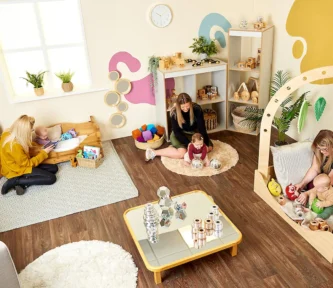
What Should you Consider when Creating an Early Years Environment?
When creating an outstanding early years environment there are a few key things to remember. Your environment should:
- Look and feel safe, secure and nurturing, including spaces for quiet, talk and purposeful play and learning.
- Be an inclusive and multi-sensory space.
- Inspire children to learn – offering stimulation and provocation to engage their natural curiosity,
- Be rich with learning opportunities to build children’s knowledge and skills through all areas of development.
- Foster a culture that values and loves learning.
- Create a sense of belonging.
These are some of the key ingredients which will encourage children to flourish and through a variety of different approaches to learning will ensure they become the best they can be. If you need inspiration for creating an early years environment which provide nurturing and purposeful spaces, read more on our Inspiring Early Years page.
Blog updated in March 2026.